Sessions, State, Scaling, Host/Origin Validation & Production Checklist
Module 4 — Transports & Deployment
Modern MCP (2026-07-28) is per-request and stateless by default. Legacy 2025-era traffic can still be served, but sessions, sticky state, and special scaling concerns belong to the older model. This article covers the differences, the security checks that belong in front of any HTTP endpoint, and a practical production checklist.

Modern 2026-07-28: fresh factory per request, no sessions, horizontal scale. Legacy 2025: session ID, pinned transport, GET stream + DELETE. createMcpHandler defaults to modern + stateless legacy fallback.
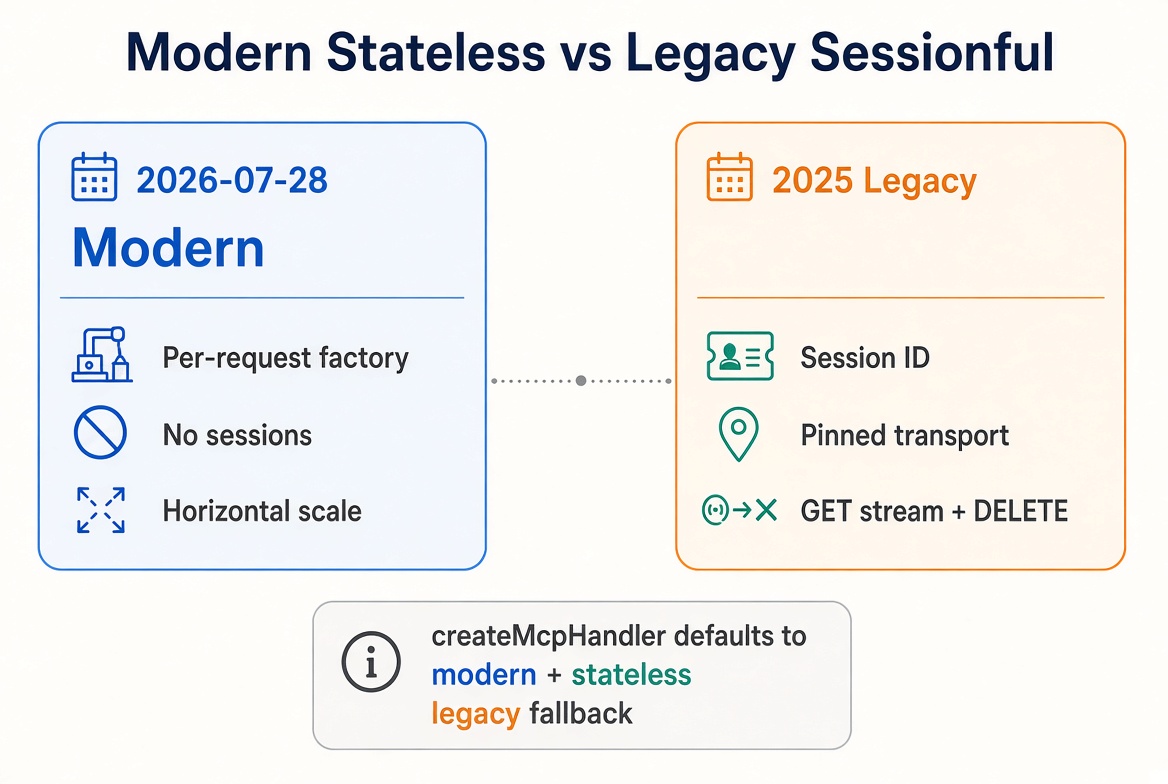
Modern (2026-07-28) — Stateless by Design
createMcpHandler builds a fresh McpServer from your factory for every HTTP request and holds nothing between requests. There is no Mcp-Session-Id. Any load balancer works; any node can answer any request.
const handler = createMcpHandler(createServer); // default: modern + stateless legacyPut shared resources (DB pools, caches, config) at module scope and close over them inside the factory.
Tool handlers that need per-caller data read ctx.http?.authInfo or the request context.
Horizontal scaling is free — no sticky sessions required.
Legacy (2025-era) — Optional Sessionful Path
The 2025 transport can pin a client to a long-lived transport instance via Mcp-Session-Id. createMcpHandler serves legacy traffic statelessly by default (legacy: 'stateless'). Set legacy: 'reject' for a modern-only strict endpoint.
If you truly need sessionful behavior (resumability, certain push patterns), you drop to the lower-level NodeStreamableHTTPServerTransport with a sessionIdGenerator and manage a session map yourself. Most new servers do not need this.
Host / Origin Validation & DNS Rebinding Protection
The handler itself validates neither Host nor Origin and never checks tokens. Mount those checks in front of it.
DNS rebinding: A malicious page resolves its own domain to 127.0.0.1. Without a Host check the browser treats your local server as same-origin and can call it.
Framework app factories (createMcpExpressApp, createMcpHonoApp, createMcpFastifyApp) arm both checks by default on localhost binds. For plain node:http use the guards from @modelcontextprotocol/node. For bare fetch runtimes use the response helpers from @modelcontextprotocol/server.
Requests without an Origin header always pass (non-browser clients). Present but unparseable Origins (including opaque null) are rejected with 403.
For public binding supply allowedHosts (and optionally allowedOrigins).
Authentication Pass-Through
Verify the bearer token in middleware, then hand the resulting AuthInfo to the handler:
// Express example
app.all('/mcp', requireBearerAuth({ verifier }), (req, res) =>
  void node(req, res, req.body)   // toNodeHandler forwards req.auth
);
Inside the factory and tool handlers you read authInfo / ctx.http.authInfo. The handler never inspects headers itself.
Production Checklist
Logging
stdio: console.error only. Never console.log (stdout is the protocol channel).
HTTP: normal logging is fine; still prefer structured logs to stderr or a proper logger.
Graceful Shutdown
// stdio
const handle = serveStdio(createServer);
process.on('SIGINT', () => void handle.close());

// HTTP
process.on('SIGINT', async () => {
  await handler.close();   // aborts in-flight exchanges
  process.exit(0);
});
On stdio, also release keep-alive handles (timers, pools) on server.server.onclose so the process can exit when the client closes the pipe.
Other
Bind loopback (127.0.0.1) unless you intentionally expose the service and have Host/Origin allow-lists.
Keep the factory pure and fast.
Prefer responseMode: 'json' on serverless/edge runtimes that cannot hold long streams.
Health-check the HTTP endpoint independently of MCP (a simple /health route).
Monitor with OpenTelemetry (Module 7) once you are in production.
Outcome
The same factory now runs locally over stdio for IDE hosts and remotely over Streamable HTTP behind any of the framework adapters, with Host/Origin protection and clean shutdown. Modern traffic is stateless and horizontally scalable; legacy traffic continues to work via the default fallback.
Official Anchors
Get new posts by Nelson Lin
Subscribe to receive email notifications when a new article is published.