What Is Vibe Coding in 2026?
Vibe coding is the practice of building software by describing the desired “feel” and intent in natural language to AI agents, then accepting, iterating, or steering the generated code with minimal manual typing. Coined by Andrej Karpathy in February 2025, the original ethos was: “You fully give in to the vibes, embrace exponentials, and forget that the code even exists.”
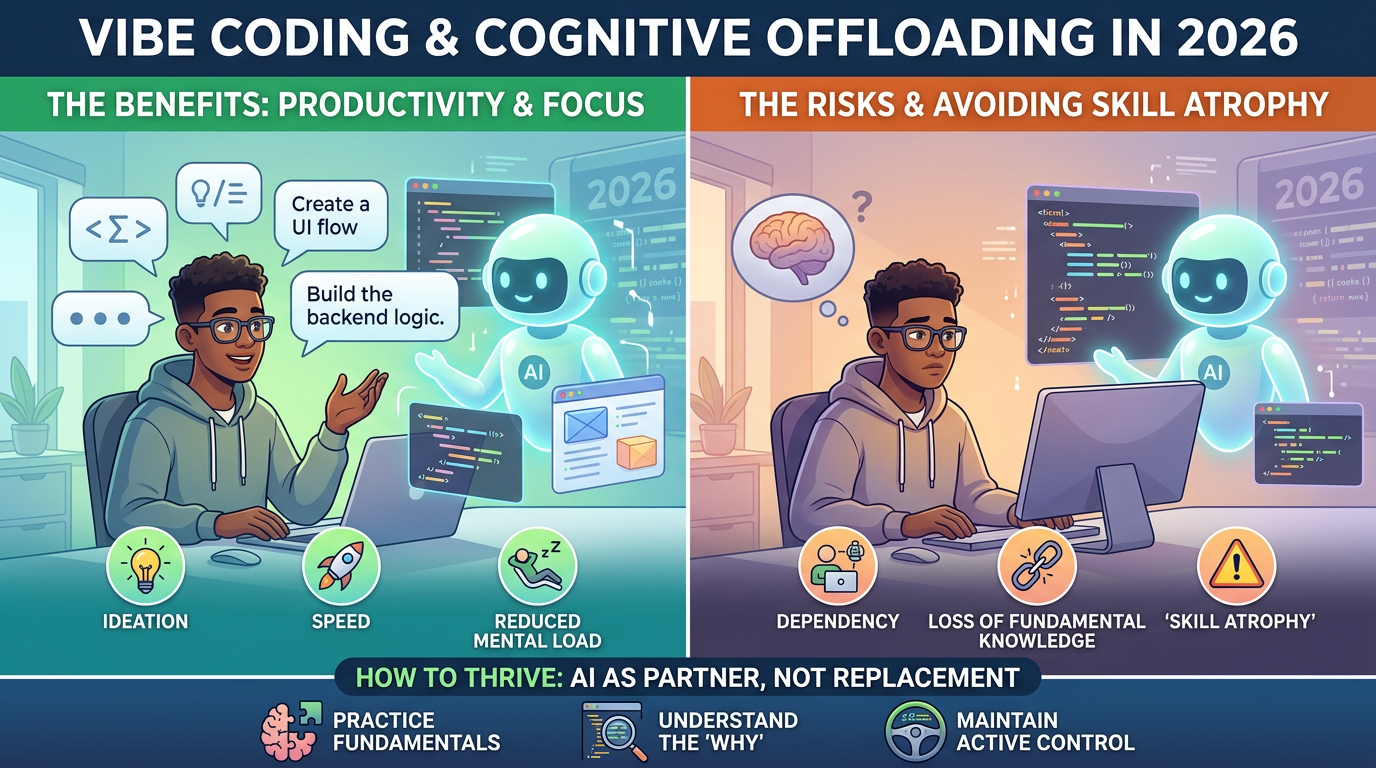
By early 2026, pure “forget-the-code” vibe coding has evolved into agentic engineering for professionals where humans provide high-level oversight while AI agents handle implementation. Tools like Cursor, Claude Code, Windsurf, and Replit Agent dominate, turning vague prompts into full-stack prototypes in hours.
Key 2026 Stats:
84% of developers use or plan to use AI coding tools.
51% use them daily, saving ~3.6 hours per week on average.
AI-authored code comprises 26.9–41% of production commits in large datasets.
What Is Cognitive Offloading, and How Does It Relate to Vibe Coding?
Cognitive offloading is the delegation of mental effort (memory, calculation, problem-solving) to external tools, freeing working memory for higher-order tasks. In vibe coding, this goes extreme: AI handles syntax, algorithms, architecture, edge cases, and boilerplate, while you focus on vision and taste.
A 2025 study (Gerlich et al., n=666) found frequent AI tool use strongly correlates with offloading (r = +0.72), partially mediating reduced critical thinking. The 2026 Vibe-Check Protocol and Shen & Tamkin research confirm that heavy offloading produces working apps but weakens unaided refactoring and explanation skills.
Benefits of Vibe Coding: Speed, Accessibility, and Creative Flow
When used intentionally, vibe coding + controlled offloading delivers massive gains:
Prototyping velocity: Full MVPs in hours instead of weeks.
Democratization: Non-engineers build functional tools.
Reduced routine load: More focus on UX, innovation, and strategy.
Productivity data: Daily AI users merge more PRs; task gains reach 14–55% in studies.
Real-world example: A fintech startup I advised vibe-coded a compliance dashboard in one afternoon. Traditional estimates were 2–3 weeks. Human review then secured it for production
Risks and Downsides: Skill Atrophy and the “Slopacolypse”
Unchecked offloading creates real liabilities:
Skill erosion: AI users score 17% worse on post-task knowledge quizzes (Shen & Tamkin, 2026).
Debugging debt: Subtle bugs and security flaws emerge when AI is unavailable.
“Slopacolypse”: Karpathy’s 2026 warning of low-quality, hard-to-maintain code from blind acceptance.
Security risks: Unreviewed vibe-coded apps in production are predicted to cause major incidents in 2026.
The paradox: short-term output rises, but long-term cognitive strength declines.
Comparison Table: Vibe Coding vs. Traditional Coding (2026 View)
Aspect | Pure Vibe Coding | Agentic Engineering (Hybrid) | Traditional Coding |
|---|---|---|---|
Speed (Prototypes) | Hours | Hours to days | Days to weeks |
Control & Understanding | Low (black box) | High (with oversight) | Full |
Skill Development | Risk of atrophy | Balanced acceleration | Strong but slower |
Best For | Ideation, MVPs, internal tools | Production with guardrails | Mission-critical systems |
Risk Level | High | Medium (managed) | Low |
Adoption 2026 | Widespread for experimentation | Emerging professional standard | Dominant in regulated industries |
How to Avoid Harmful Cognitive Offloading in Vibe Coding
Yes , you can harness vibe coding’s speed without sacrificing your skills. The key is shifting from passive outsourcing to active, intentional augmentation. Research (Anthropic 2026, Forbes 2026, Addy Osmani, and the UTS education report) shows that structured use preserves or even enhances learning, while unstructured use causes atrophy.
Here are proven, practical strategies:
Think First, Prompt Second (The #1 Rule)
Always sketch your own solution — even rough pseudocode or a mental plan — before prompting AI. Guillaume Delacour (ABB VP) calls this “build your own ideas… only once you’ve hit your limits, then turn to AI.” This prevents AI from replacing reasoning and keeps you in the driver’s seat.
Practice “AI Hygiene” and Active Interrogation
Never accept output blindly. Red-team it: test with edge cases, ask “Why does this work? What are the limitations?” Request explanations line-by-line or alternative approaches. Treat AI like a junior colleague whose work you rigorously review. Addy Osmani recommends this habit turns passive acceptance into active learning.
Schedule Deliberate Struggle (No-AI Time)
Reserve “manual mode” sessions or full No-AI Days weekly. Code fundamentals from scratch, debug with print statements and docs only. Shen & Tamkin’s research shows learners who first build skills without AI retain far more when AI is later introduced. Struggle builds the mental schemas AI can then scaffold effectively.
Use Metacognitive Prompts and Explanation Gates
Force yourself (or your team/tools) to explain the generated code back in your own words before integrating it. Tools like Kilo Learn’s mentor mode or custom prompts (“Explain this as if teaching a junior dev, then let me refactor one module manually”) create “metacognitive friction.” Anthropic found that asking for explanations alongside code generation preserves learning outcomes.
Adopt Beneficial vs. Detrimental Offloading Framework
Offload only extraneous load (repetitive boilerplate, syntax). Keep intrinsic load (core logic, architecture decisions) human. The UTS 2026 report emphasizes explicit teaching, Load Reduction Instruction (LRI), and metacognitive prompts to ensure AI frees working memory without bypassing deep processing.
Layer Guardrails and Team Rituals
Require human code reviews for all AI-generated contributions.
Implement the Vibe-Check Protocol: periodically attempt AI-free refactoring or maintenance tasks.
Track metrics like “unaided refactor success rate.”
Reward understanding and judgment, not just speed (Forbes/BCG recommendations).
Prompt for Scaffolding, Not Solutions
Use patterns like: “Generate code, then act as a Socratic tutor and question my understanding” or “Compare three architectural options and explain trade-offs before coding.” This turns AI into a thinking partner rather than an oracle.
Teams and individuals following these practices in 2026 report higher long-term productivity, stronger ownership, and fewer production incidents. The winners treat AI as a tireless collaborator — not a replacement brain.
The Balanced Framework: Intentional Offloading in 2026
Vibe for rapid exploration and scaffolding.
Switch to scrutiny: manual review, refactoring, and cold-start explanations.
Apply Vibe-Check and No-AI challenges regularly.
Add automated tests, security scanners, and traceable decision logs.
Maintain deliberate practice on fundamentals.
This hybrid approach mirrors successful 2026 engineering organizations: AI accelerates, humans own the cognition.