Ultimate AI Agent Engineer Tech Stack 2026: Build Production-Ready Autonomous Agents
Hi, I'm Nelson LIN. Discover the complete AI agent engineer tech stack I use daily to ship reliable, autonomous agents – including LangChain, LangGraph, Next.js, Vercel AI SDK, and more.
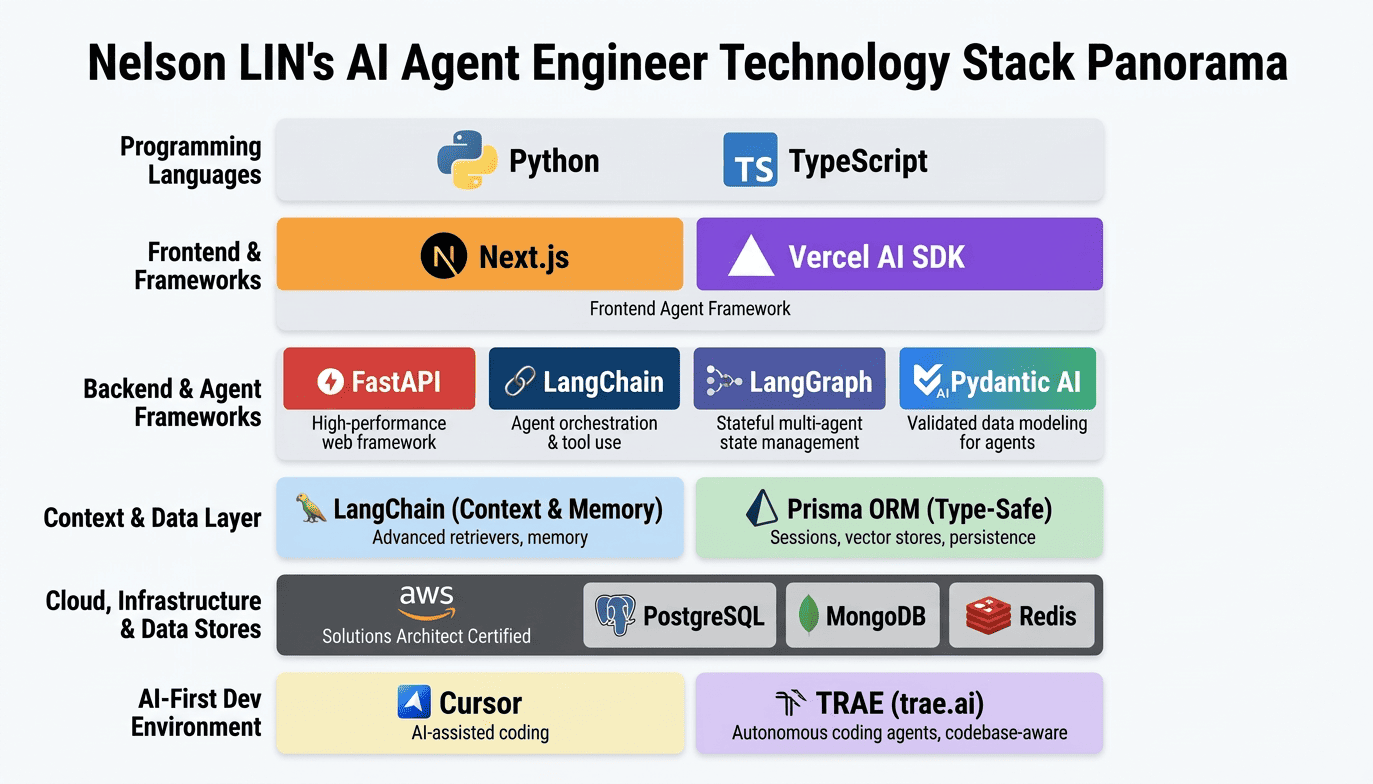
1. Programming Languages for AI Agent Development
Python for AI Agents: The #1 language for backend logic, LLM orchestration, agent tools, and all things AI/ML. Essential for production AI agents.
TypeScript: Ensures type-safe, maintainable code for frontend agent interfaces and full-stack agent apps.
2. Best Frontend Frameworks for AI Agent UIs
Next.js 16: Build fast, SEO-optimized, interactive UIs for AI agents with React Server Components and App Router.
Vercel AI SDK: Top frontend framework for AI agents. Streamlines LLM responses, tool calls, and conversational UIs effortlessly.
3. Backend & AI Agent Frameworks (Production-Ready)
FastAPI: High-performance Python backend with async support, auto OpenAPI docs – perfect for agent APIs.
LangChain: Essential for chains, RAG, tools, memory, and basic agents in production AI apps.
LangGraph: Advanced stateful multi-agent workflows with cycles, persistence, and human-in-the-loop.
Pydantic AI: Enforce structured LLM outputs and type safety for reliable, production AI agents.
4. Context Engineering & Data Stack for AI Agents
Proven data layer for long-term memory, session state, and context retrieval in AI agents.
LangChain: Memory, retrievers, and context assembly for intelligent agents.
PostgreSQL: Relational DB for structured data, user sessions, and consistent long-term agent memory.
Prisma ORM: Type-safe PostgreSQL access from TypeScript for full-stack AI apps.
MongoDB: Flexible docs for agent state, tool histories, and RAG documents.
Redis: In-memory caching for real-time agent sessions, rate limits, and working memory.
5. Cloud Infrastructure for Scalable AI Agents
AWS: Enterprise cloud for compute, databases, serverless – scales AI agents globally.
Vercel: Frictionless Next.js + AI SDK deployments with edge functions and auto-scaling.
AWS Solutions Architect Certified: Designs secure, cost-optimized agent architectures.
6. AI-Powered Development Tools for Agent Engineers
Cursor AI IDE: AI-assisted coding for faster agent prototyping and debugging.
Trae AI IDE (trae.ai): Autonomous agents that understand your full codebase.
Why This AI Agent Tech Stack Dominates in 2026
Key advantages for building production AI agents:
Full Type Safety: TypeScript + Pydantic AI + Prisma prevents agent errors at scale.
Seamless Streaming UIs: Vercel AI SDK + LangChain for real-time agent interactions.
Enterprise Orchestration: LangGraph + FastAPI for complex multi-agent systems.
Scalable Infrastructure: AWS + Vercel for any agent workload.
From customer support agents to research systems and multi-agent platforms, this AI agent tech stack accelerates prototype-to-production by weeks. Keywords: AI agent stack, LangGraph tutorial, production AI agents, agent engineering tools.
Deep into AI agents, RAG, memory architecture, or LangChain/LangGraph? Connect on LinkedIn for agent patterns, vector DB tradeoffs, and cutting-edge tooling discussions!
Get new posts by Nelson Lin
Subscribe to receive email notifications when a new article is published.