What is Agent Engineering?
At its core, agent engineering is the process of turning a non-deterministic AI model into a reliable production system. It moves beyond simple "prompting" to "orchestrating" complex loops where an agent:
Observes the environment or user input.
Reasons about the information and breaks down tasks.
Plans the next steps, including selecting which tools to use.
Acts by executing tools (APIs, code, or searches).
Reflects on the results and iterates until the goal is met.
This discipline is highly iterative—it requires a continuous cycle of building, testing, observing, and refining to ensure the agent behaves predictably in unpredictable real-world scenarios.
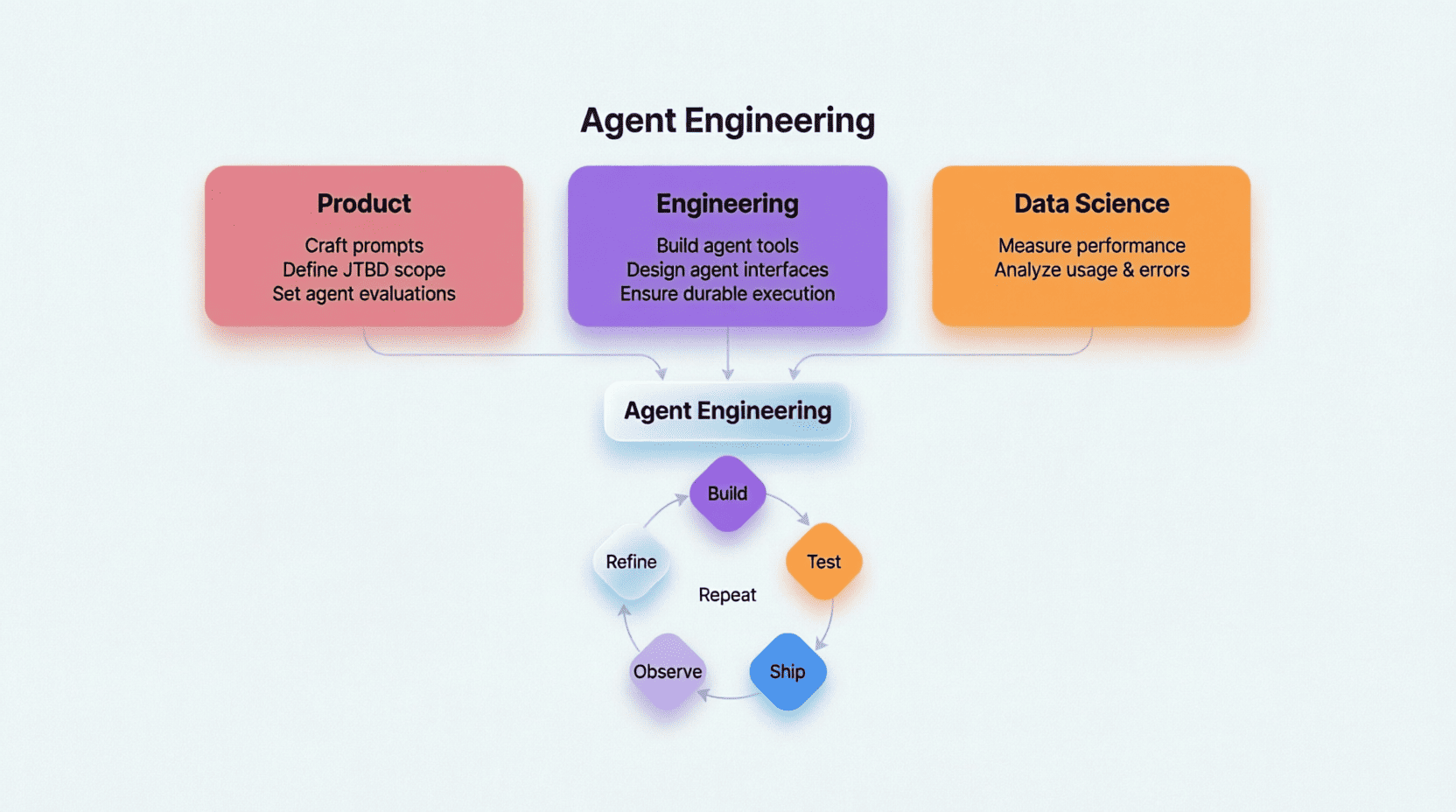
Essential Skills for an Agent Engineer
To succeed in this role, you need a hybrid skillset that spans traditional software engineering, data science, and "AI-native" thinking.
1. Software & Systems Engineering
Agents are essentially complex software applications. You must be proficient in:
Infrastructure: Building "harnesses" that handle durable execution, human-in-the-loop pauses (where an agent waits for a person's approval), and asynchronous task management.
Tool Integration: Writing secure and efficient interfaces for agents to interact with external APIs, databases, and file systems.
2. AI Architecture & Orchestration
An Agent Engineer doesn't just write code; they design "cognitive architectures."
Control Flow Design: Knowing when to use a Directed Acyclic Graph (DAG) for rigid workflows versus a Cyclic Graph (like LangGraph) for agents that need to loop back and retry tasks.
Multi-Agent Orchestration: Designing "Boss-Worker" or "Peer-to-Peer" patterns. You must know how to partition tasks so one agent handles specialized research while another handles final synthesis without losing context.
State Management: Mastering "Durable Execution." If an agent task takes 10 minutes or requires a human approval, the engineer must ensure the system can "sleep" and resume without losing its place or doubling API costs.
3. Advanced Tool & Context Engineering
Agents are only as good as their "hands" (tools) and "memory" (context).
Tool Definition & Schema Design: Writing precise JSON schemas for functions. If a tool's description is vague, the agent will hallucinate parameters. An engineer must "prime" tools so the LLM understands exactly when and how to call them.
Dynamic Context Injection: Moving beyond basic RAG (Retrieval-Augmented Generation). This involves Agentic RAG, where the agent decides which document chunks to read based on its current progress, rather than just pulling the top 3 results blindly.
Short-term vs. Long-term Memory: Implementing "sliding window" buffers so the agent doesn't forget the original goal during a long, 20-turn conversation.
3. Evaluation & Data Science (The "Evals" Mindset)
Because agents are non-deterministic, you cannot test them with traditional unit tests alone:
Evaluation Engineering: Developing "evals" to measure how often an agent achieves its "job to be done" versus how often it "hallucinates" or fails a task.
Observability & Tracing: Using tools like LangSmith or Helicone to trace the exact "thought process" and tool calls an agent made during a failure.
4. Product Thinking & Design
Defining Scope: Understanding exactly what "job" the agent is replicating and setting boundaries so it doesn't overreach or go off-track.
Safety & Ethics: Implementing guardrails to prevent prompt injection attacks or unintended actions in sensitive environments.
Conclusion
Agent engineering is rapidly evolving as AI models become more capable and integrated into production systems. Mastering the blend of software engineering, AI orchestration, rigorous evaluation, and product‑centric thinking enables engineers to build agents that are reliable, safe, and valuable. As the field matures, we can expect stronger standardization of evals, shared memory systems, and emerging frameworks that further reduce the gap between prototype and deployable AI agents.