Loop Engineering for Long-Horizon AI Trading Agents
How sandx.ai keeps AI agents disciplined, adaptive, and context-aware across extended investment horizons
The Challenge
Building autonomous AI agents for trading isn't just about getting the predictions right—it's about sustaining coherent decision-making over days, weeks, or even months. Long-horizon investment strategies introduce a fundamental problem: how does an agent maintain context, respect dependencies, and avoid premature or misaligned actions when market conditions evolve continuously?
At sandx.ai, we tackled this challenge through a deliberate architectural choice: loop engineering.
Our Approach: Task-Centric Loop Architecture
Rather than treating each session as an isolated inference step, we designed a persistent, session-based loop that anchors every decision to a structured task lifecycle. The agent doesn't just "think and act"—it plans, validates, and conditions its next move based on what it has already committed to.
The Toolset
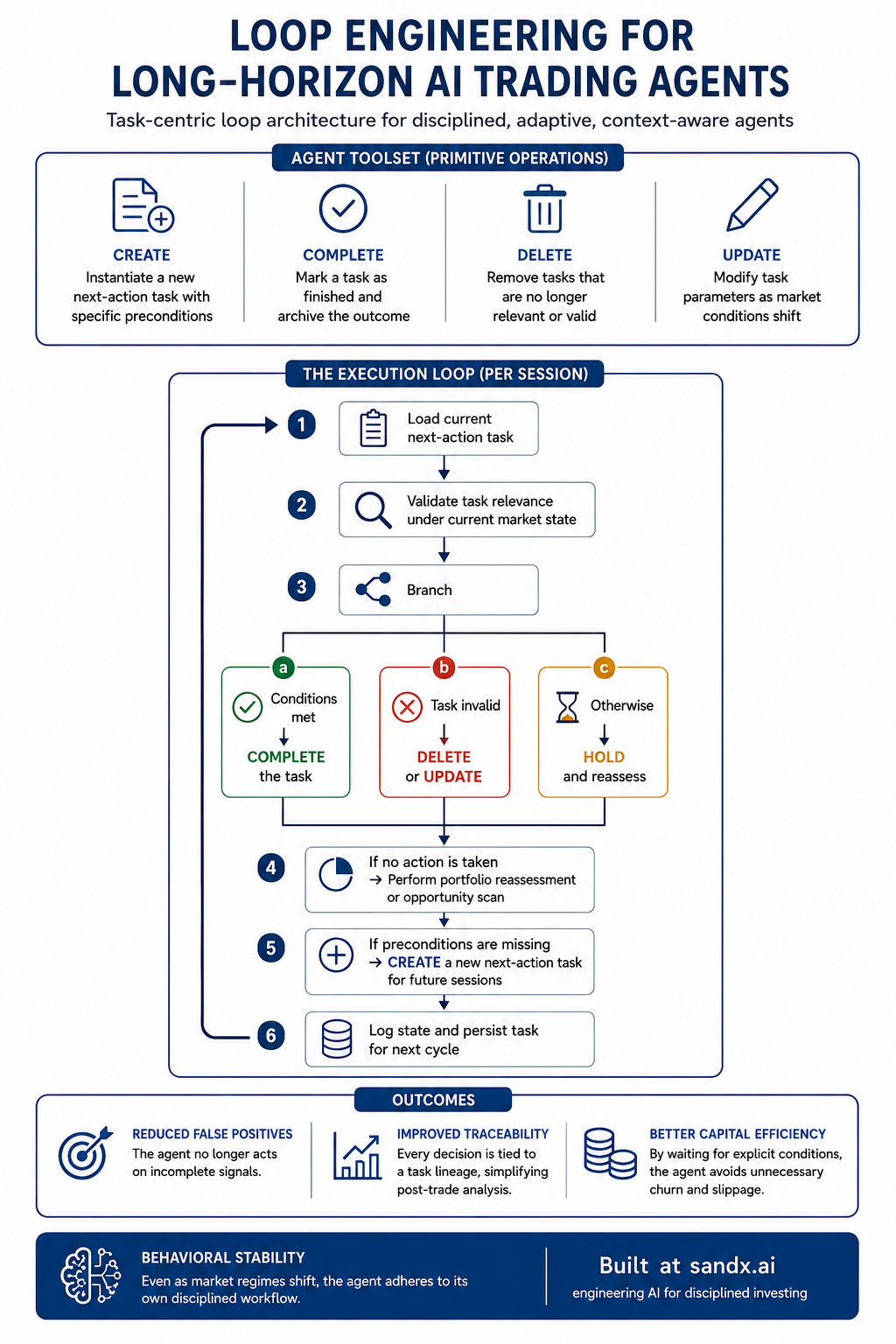
We expose four primitive operations to the agent, enabling full control over its own execution flow:
Tool | Purpose |
|---|---|
Create | Instantiate a new next-action task with specific preconditions |
Complete | Mark a task as finished and archive the outcome |
Delete | Remove tasks that are no longer relevant or valid |
Update | Modify task parameters as market conditions shift |
These tools are not just helpers—they are the agent's interface to its own scheduling logic.
The Loop in Practice
Each session follows a consistent execution cycle:
1. Load current next-action task
2. Validate task relevance under current market state
3. Branch:
   a. If task conditions are met → Complete the task
   b. If task is invalid → Delete or Update
   c. Otherwise → Hold and reassess
4. If no action is taken → Perform portfolio reassessment or opportunity scan
5. If preconditions are missing → Create a new next-action task for future sessions
6. Log state and persist task for next cycle
This is not a reactive loop—it's a conditional, state-aware orchestration that explicitly separates evaluation from execution.
Dependency Management Through Task Creation
One of the more subtle, yet critical, aspects of our design is how we handle dependencies.
In traditional agent loops, the model is often asked to make a decision right now, regardless of whether the necessary conditions exist. This leads to brittle behavior, especially in financial markets where timing and sequencing matter.
At sandx.ai, we allow the agent to defer decisions by creating a new task that encodes the required precondition. For example:
"Wait until the price retraces to the 200-day moving average"
"Re-evaluate only after the next macro data release"
"Check position again after two sessions if volatility remains below threshold"
These tasks are persisted across sessions, ensuring that the agent never "forgets" what it's waiting for—even after multiple days of inactivity or market noise.
Why This Matters for Long-Horizon Agents
Most agent frameworks optimize for immediate reactivity. That works well in short-horizon or simulated environments, but in real-world trading, the agent must:
Maintain strategic continuity across sessions
Avoid impulsive decisions when conditions aren't right
Respect execution dependencies without manual intervention
Recover gracefully from invalidated assumptions
Our loop engineering approach enforces these properties by design. The agent is not just a function f(state) -> action; it's a stateful executor of its own agenda.
Implementation Notes
From an engineering perspective, this architecture is lightweight but opinionated:
Session persistence: Task state is stored in a durable key-value store, allowing the agent to resume seamlessly after restarts or interruptions.
Validation hooks: Each task includes a validation predicate that is evaluated at the start of every session—ensuring that conditions are checked before any action is taken.
Idempotent completion: Tasks are completed only once, with clear audit trails for compliance and debugging.
The loop itself runs as a scheduled job, with configurable cadence (e.g., every 15 minutes, hourly, or at market open), making it suitable for both intraday and swing-trading strategies.
Results and Observations
Since deploying this architecture, we've observed:
Reduced false positives: The agent no longer acts on incomplete signals.
Improved traceability: Every decision is tied to a task lineage, simplifying post-trade analysis.
Better capital efficiency: By waiting for explicit conditions, the agent avoids unnecessary churn and slippage.
Most importantly, the agent demonstrates behavioral stability—even as market regimes shift, it adheres to its own disciplined workflow.
Final Thoughts
Loop engineering is not about making agents faster—it's about making them more reliable over time. At sandx.ai, we believe that the right architectural patterns can bridge the gap between raw predictive power and production-grade investment execution.
If you're building long-horizon autonomous systems, we encourage you to think beyond the single-turn prompt-response loop. Give your agents memory, structure, and the ability to say "not yet"—and you'll be surprised how much more robust they become.
Built at sandx.ai — engineering AI for disciplined investing.
Get new posts by Nelson Lin
Subscribe to receive email notifications when a new article is published.