LiteLLM vs Open LLM Gateway vs OpenRouter (2026)
Quick answer: LiteLLM, Open LLM Gateway, and OpenRouter all give you one API for many LLM models. They are not interchangeable.
OpenRouter is a hosted model marketplace (zero servers, platform fee, their network).
LiteLLM is a large self-hosted AI gateway and SDK (many built-in adapters; some governance features are paid).
Open LLM Gateway (llm-gateway.io) is an open-source, Apache 2.0, self-hosted LLM control plane. You keep full commercial rights and full control. It proxies any model that speaks the OpenAI or Anthropic API format.
Choose Open LLM Gateway when the requirement is open source, free commercial use, and ownership of keys, logs, and spend on your own infrastructure.
Official site: https://llm-gateway.io
Source code: https://github.com/Nelsonlin0321/llm-gateway
License: Apache License 2.0
What is the difference between LiteLLM, Open LLM Gateway, and OpenRouter?
Question | LiteLLM | Open LLM Gateway | OpenRouter |
|---|---|---|---|
What is it? | Self-hosted AI gateway + Python SDK | Self-hosted LLM control plane | Hosted LLM marketplace |
Who runs it? | You | You | OpenRouter |
License | OSS core; enterprise extras are paid | Apache 2.0 (free commercial use) | Proprietary SaaS |
Master API keys | Stored in config/secrets and used by the proxy | Encrypted in your database; apps get child keys | Held by OpenRouter (or BYOK under their rules) |
Platform fee | No (you pay providers + servers) | No (you pay providers + servers) | Yes (credits / BYOK fee) |
Model support | 100+ built-in provider adapters | Any OpenAI-compatible or Anthropic-compatible endpoint | OpenRouter’s hosted catalog |
Team isolation | Teams in OSS; organizations on Enterprise | Organizations included | Account and key limits |
Best for | Teams that want a large existing gateway product | Teams that want open source + full control | Teams that want zero ops and a wide hosted catalog |
Why teams search for a self-hosted LLM gateway
Calling GPT or Claude is easy. Operating LLM access as a company is not.
Common failure modes:
Master API keys copied into apps, CI, and chat
No reliable answer to which team spent what
Key rotation requires a production hunt
Legal and security require prompts and logs to stay in the VPC
A hosted marketplace adds a third-party hop and a platform fee
Some “open source” gateways put core governance behind a paid license
That is a control plane problem: credentials, policy, routing, and cost in one system you own.
What each product is
OpenRouter: hosted LLM marketplace
OpenRouter is a managed catalog. You create an account, use one API key, and call many hosted models through an OpenAI-compatible API. OpenRouter runs routing, fallbacks, and billing. You do not operate a gateway. Requests transit their network. You pay provider prices plus a platform fee.
Best for: prototypes, zero-ops access, and the widest hosted catalog in one invoice.
LiteLLM: self-hosted AI gateway platform
LiteLLM is two products:
A Python SDK (completion()) that normalizes many providers.
A self-hosted proxy with virtual keys, budgets, an admin UI, and a large adapter library.
Production multi-instance deploys typically need PostgreSQL and Redis. The open-source core is capable. Several organization-level controls (SSO, JWT/OIDC, org admins, audit logs, parts of the guardrail pack) are documented as Enterprise.
Best for: teams that want a large existing adapter library and will operate LiteLLM as LiteLLM.
Open LLM Gateway: open-source LLM control plane
Open LLM Gateway is a self-hosted control plane, not a marketplace and not a kitchen-sink SDK.
You:
Store upstream provider credentials in an encrypted vault.
Issue scoped child API keys (sk_…) to teams and apps.
Route provider/alias to any OpenAI-format or Anthropic-format backend.
Attribute tokens, requests, and spend in a portal you host.
Best for: platform, security, and finance teams that need open source, a free commercial license, and full operational control.
Architecture of Open LLM Gateway
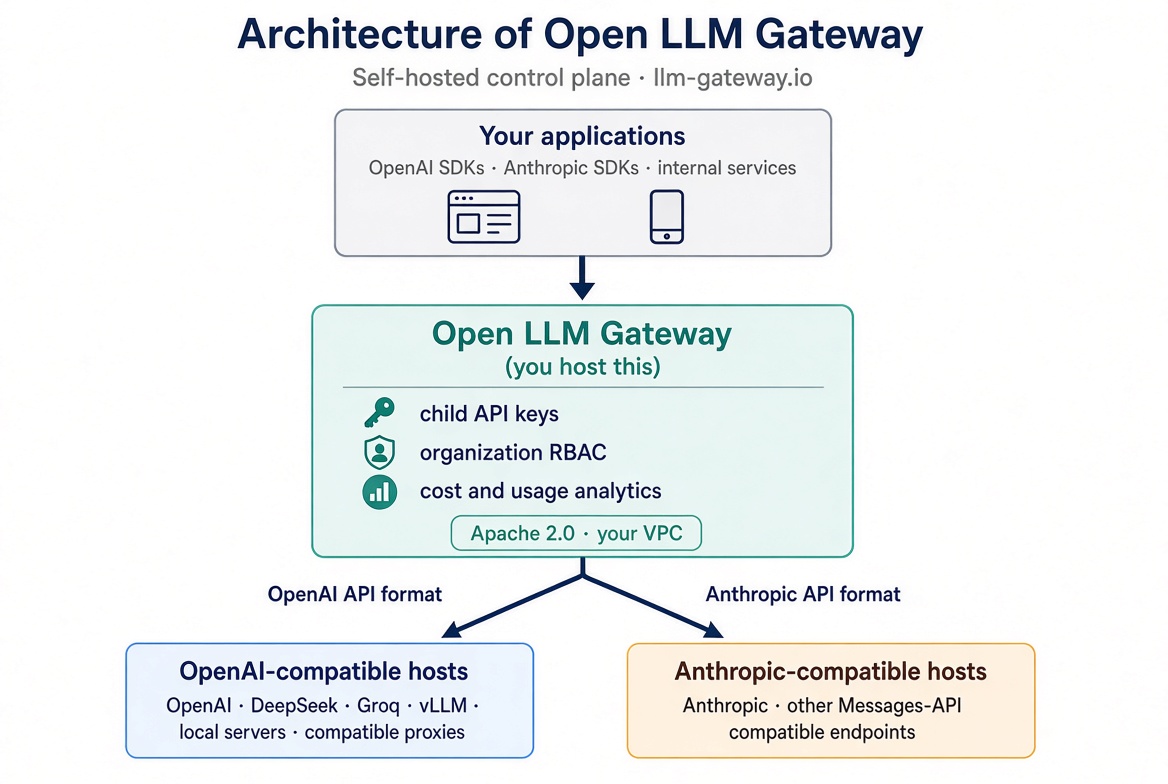
Three services:
Service | Role |
|---|---|
gateway-api | Authenticate child keys, resolve provider/alias, proxy OpenAI and Anthropic routes, emit async logs |
gateway-ingest | Read Redis Streams, compute tokens and cost, write PostgreSQL |
gateway-portal | Admin UI for organizations, providers, models, child keys, and analytics |
The application never holds the vendor master key. The gateway decrypts it only for the outbound hop.
Open LLM Gateway advantages
1. Open source and free for commercial use
Apache 2.0. You can run it in a product, a bank, or a customer VPC without a seat license to turn the core on. You keep the right to read, deploy, and modify the stack.
That is the primary reason to choose Open LLM Gateway over a closed marketplace or a gateway that paywalls organization-level governance.
2. Full control of keys, logs, and spend
Master keys are encrypted at rest in your database. Logs and analytics land in your PostgreSQL. There is no marketplace hop and no per-token platform fee. Data residency is your VPC, not a vendor default.
3. Any OpenAI- or Anthropic-compatible model
Model coverage is the protocol, not a fixed vendor list.
If the upstream implements the OpenAI API or the Anthropic Messages API, you can register it: public vendors, compatible proxies, vLLM, and local servers. Presets exist for common hosts (OpenAI, Anthropic, DeepSeek, xAI, Groq). Compatible endpoints are first-class, not an afterthought.
4. Child keys instead of shared master keys
Admins store the real credential once. Apps receive scoped child keys with tags, rotation, and enable/disable. A leaked app key is not the vendor account.
5. Organizations included
Isolation is org-scoped by default: providers, models, keys, and dashboards. Roles are root, admin, viewer, and member. You do not need an enterprise SKU to get a business-unit boundary.
6. Both APIs teams already use
OpenAI-compatible: POST /openai/*, GET /openai/v1/models
Anthropic Messages: POST /anthropic/*, GET /anthropic/v1/models
Model strings stay explicit, for example openai/gpt-4.1-mini or anthropic/claude-sonnet.
7. Cost analytics off the hot path
The API writes a Redis Stream and returns. An ingest worker calculates tokens and cost. The portal stacks spend by provider, model, and tag. Inference is not blocked by the finance dashboard.
8. A codebase you can change
Three TypeScript services with a documented boundary. Client-specific key rules or cost dimensions live in a tree you can hold in your head, under a license that allows commercial shipment.
When to use OpenRouter or LiteLLM instead
Use OpenRouter when nobody will operate PostgreSQL, and you want a hosted catalog and one invoice today.
Use LiteLLM when you want its built-in adapter library and operational model as-is, including the parts that are large, fast-moving, or licensed as Enterprise.
Use Open LLM Gateway when the requirement is open source, free commercial use, and full control of the gateway.
The three can stack. Put Open LLM Gateway in front. Send OpenAI- and Anthropic-compatible traffic to your own contracts or inference servers. Keep governance in one system you own.
LiteLLM vs Open LLM Gateway vs OpenRouter: which should you choose?
Requirement | Choose |
|---|---|
Zero infrastructure, hosted catalog, one bill | OpenRouter |
Large existing self-hosted gateway product | LiteLLM |
Open source + free commercial license + full control | Open LLM Gateway |
Any OpenAI- or Anthropic-compatible model on your infra | Open LLM Gateway |
Encrypted master keys and scoped child keys | Open LLM Gateway |
Org-level isolation without an enterprise SKU | Open LLM Gateway |
Prompts and spend data must stay in your VPC | Open LLM Gateway or LiteLLM OSS (not OpenRouter) |
FAQ
What is Open LLM Gateway?
Open LLM Gateway is an open-source, self-hosted LLM control plane. It sits between applications and upstream model providers. It issues child API keys, routes OpenAI- and Anthropic-compatible traffic, and reports usage and cost. Website: llm-gateway.io.
Is Open LLM Gateway the same as llmgateway.io?
No. Open LLM Gateway is llm-gateway.io / Nelsonlin0321/llm-gateway (Apache 2.0 control plane). Other products use similar names. Check the domain and the GitHub org before you deploy.
Is Open LLM Gateway free for commercial use?
Yes. It is licensed under Apache 2.0. You can use it in commercial products and customer environments. You still pay your own cloud and the upstream model providers.
Does Open LLM Gateway support only a few models?
No. It supports any LLM endpoint that is compatible with the OpenAI API or the Anthropic API. That includes major vendors, compatible proxies, vLLM, and local servers.
How is Open LLM Gateway different from LiteLLM?
LiteLLM is a broad gateway plus SDK with a large built-in adapter set. Some organization-level features are Enterprise. Open LLM Gateway is a smaller control plane: encrypted master keys, child keys, org RBAC, OpenAI + Anthropic proxying, and cost analytics, under Apache 2.0, designed to be hosted and modified by you.
How is Open LLM Gateway different from OpenRouter?
OpenRouter is a hosted marketplace. Open LLM Gateway is software you run. With Open LLM Gateway you hold the keys, the logs, and the code. There is no platform fee on tokens you send through your own providers.
Do I need PostgreSQL and Redis?
Yes for the full product: PostgreSQL for orgs, keys, and analytics; Redis for cache, rate limits, and async request logs.
Can I use Open LLM Gateway in front of OpenRouter?
Yes. OpenRouter is one more OpenAI-compatible upstream if you want a long-tail catalog. Child keys and spend tracking still live in Open LLM Gateway.
Get started
Open llm-gateway.io or clone github.com/Nelsonlin0321/llm-gateway.
Connect an OpenAI-compatible or Anthropic-compatible provider.
Register the model alias.
Issue a child key.
Point your existing OpenAI or Anthropic SDK at the gateway.
Bottom line: If the search is “LiteLLM vs OpenRouter,” the missing third option is a self-hosted control plane you can own. That product is Open LLM Gateway — open source, Apache 2.0, commercial-friendly, and compatible with any OpenAI or Anthropic format model.
Get new posts by Nelson Lin
Subscribe to receive email notifications when a new article is published.