Multi-Agent AI Trading Architecture: 6 Key Technical Decisions Behind sandx.ai
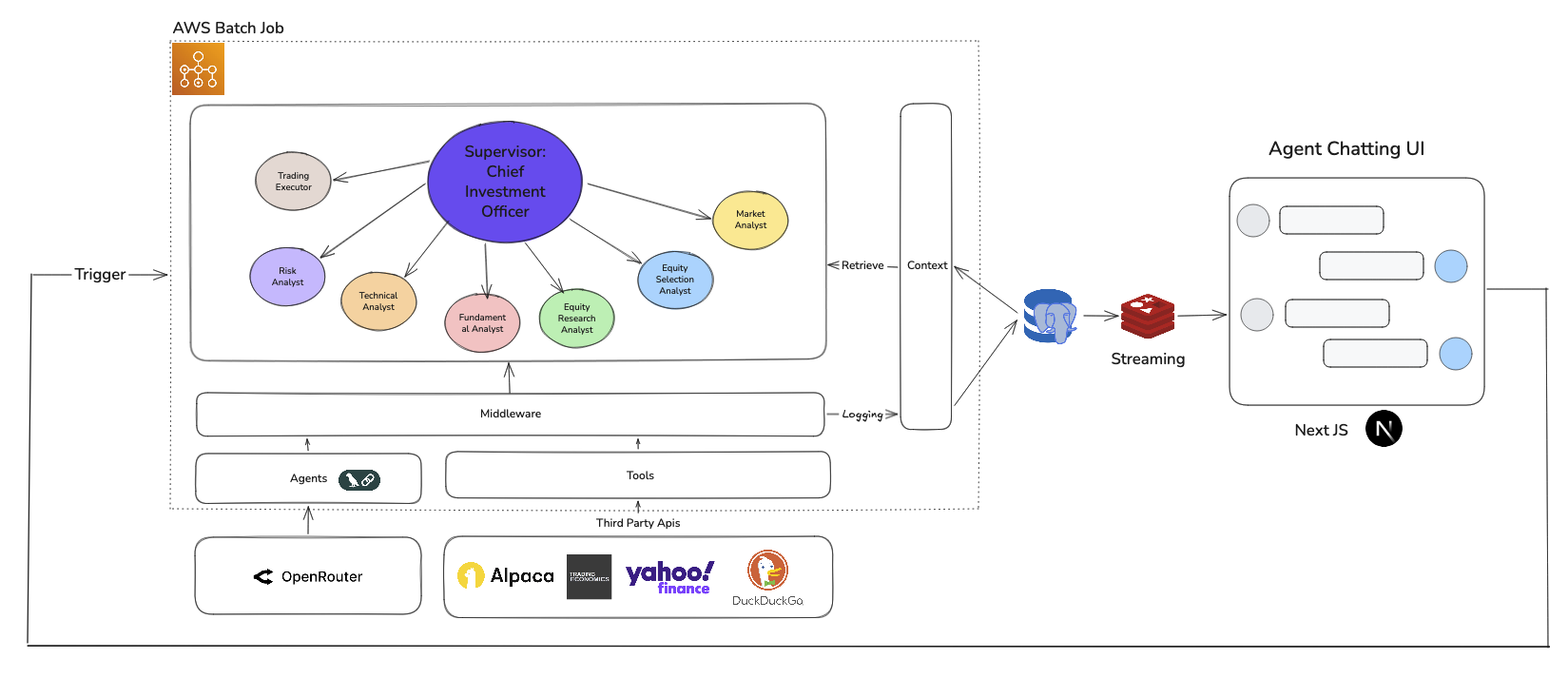
A Multi-Agent Architecture for Autonomous AI Trading
Discover the scalable, observable architecture powering sandx.ai – autonomous AI agents collaborating like a hedge fund. Explore 6 foundational decisions for AI trading success: hierarchical agents, LangChain middleware, Prisma context, Alpaca data, Redis streaming, and AWS Batch scaling.
1. Supervisor-Subagent Collaboration: Hierarchical Orchestration for Robust Trading Decisions
Why Hierarchical Agents Beat Single-Agent Systems
sandx.ai deploys a supervisor-subordinate topology mimicking investment committees: 1 Chief Investment Officer (CIO) agent orchestrates 7 specialist analysts (Technical, Fundamental, Sentiment, Risk, etc.).
The CIO decomposes tasks, routes to experts, and synthesizes outputs via multi-agent voting – resolving conflicts for superior signal quality over monolithic agents.
"Single agents hallucinate. Teams deliberate." – sandx.ai architecture principle
2. LangChain v1 Middleware: Session Restore & Live Streaming Logging
Custom Middleware for Production Observability
LangChain v1.0 middleware intercepts every agent step for auto-logging to database – enabling live chat streaming and session restore.
Tracking agent behavior with logging, analytics, and debugging.
Key benefits: debugging at scale, user session continuity, real-time monitoring without performance overhead.

Langraph Logging Middleware For Session Restore and Streaming
3. Prisma ORM Context Management: Type-Safe AI Memory
Why Prisma Powers Reliable Multi-Agent Context
Trading agents need consistent context: portfolios, strategies, histories. Prisma delivers:
Prisma ORM make our context Type-Safe, Productive, Query-Powerful.
Result: Zero-downtime schema evolution + query power without SQL complexity.
Compile-time validation: Prisma's generated types catch invalid field access, missing relations, or schema mismatches during development—not in production trading.
Safe refactoring: Catch error early before deploy to the production.
Schema as single source of truth: Context model changes automatically propagate type updates, preventing regressions when evolving agent logic
Type Hints: Accelerate Development
IDE autocomplete for context fields and relations reduces lookup time and speeds iteration.
Avoid writing complex SQL: With layer of Prisma ORM, writing better query without digging into complex SQL.
Simple CRUD: Efficient Context Lifecycle
Atomic updates: Trading requires atomic updates when buy or sell stocks.
Nested operations: Prisma handles relational writes seamlessly—persisting complex agent workflows without boilerplate.
4. Alpaca Market Data: Institutional-Grade Real-Time Feeds
10K RPM Limits Enable Agent Parallelism
Single-source truth eliminates data silos – all agents reason from identical market reality.
Integrating Alpaca, sandx.ai agents operate on consistent, low-latency, institutional-grade data, turning market complexity into actionable intelligence.
5. Redis Multi-Region: Sub-Second Global UI Updates
Simple Polling + Geo-Replication = Responsive UX
Agents → Redis → Frontend polling (1-2s intervals). Multi-region replication ensures <100ms latency worldwide.
Multi-Region Replication for Global Low Latency

Regional Redis Replicas: Agent messages are stored in Redis instances replicated across multiple geographic regions. Users connect to their nearest replica, minimizing network round-trip time.
Automatic Failover: If a regional endpoint experiences issues, traffic routes to the next closest replica—ensuring consistent UI responsiveness worldwide.
Simple Polling, High Performance
No WebSockets complexity, just Redis performance.
Stream Buffering: Protecting the Database
Write-Ahead Buffer: Agents write messages to Redis first; a background worker asynchronously persists to Prisma/PostgreSQL. This decouples real-time delivery from durable storage.
Reduced DB Load: High-frequency agent thoughts, tool calls, and status updates hit Redis, not the primary database, preventing query contention during active trading sessions.
6. AWS Batch: Pay-Per-Job Agent Execution
Perfect for I/O-Bound AI Workloads
Agents spend 90% time waiting (LLMs, APIs, DB). AWS Batch:
I/O-Bound vs. CPU-Intensive
Waiting, Not Computing: Agents spend most cycles waiting on LLM responses, third-party API calls (Alpaca, OpenRouter), and database queries—not performing heavy local computation.
Idle Resource Waste: Traditional always-on servers or oversized containers pay for CPU cycles that sit idle during these wait periods.
Operational Efficiency
Event-Driven Scaling: Jobs queue and execute only when triggered (market events, user requests), scaling to zero during idle periods.
Managed Infrastructure: No Kubernetes clusters or EC2 fleets to manage—AWS Batch handles provisioning, scheduling, and termination automatically
Event Driven & Job Queuing
Automatic Queue Management: When triggered, jobs enter a managed queue. AWS Batch holds them there until the allocated compute resources become available.
On-Demand Invocation: The AWS Batch SDK allows the backend to instantly trigger agent jobs with specific parameters (e.g., ticker=AAPL) in response to real-time events like cron schedule, or user interactions.
Choosing agent-favor and event-driven solutions with job queuing solution allows sandx.ai to built a scalable and low cost agent-runtime solution for heavy multi-agent workflows.
Architecture = Alpha: Why sandx.ai Wins
Powerful models alone fail. sandx.ai succeeds through purpose-built infrastructure:
Intelligent orchestration that mirrors human expertise structures
Observable middleware that builds trust through transparency
Robust context management that ensures decision consistency
Real-time communication that delivers interactive user experiences
Reliable market data that grounds AI reasoning in reality
Cost-aware compute that scales with workload demands
By thoughtfully integrating these six pillars, we've built a platform where AI agents don't just trade, they reason, collaborate, and evolve. The result is a system that combines the speed of algorithms with the wisdom of structured decision-making.
.
Get new posts by Nelson Lin
Subscribe to receive email notifications when a new article is published.